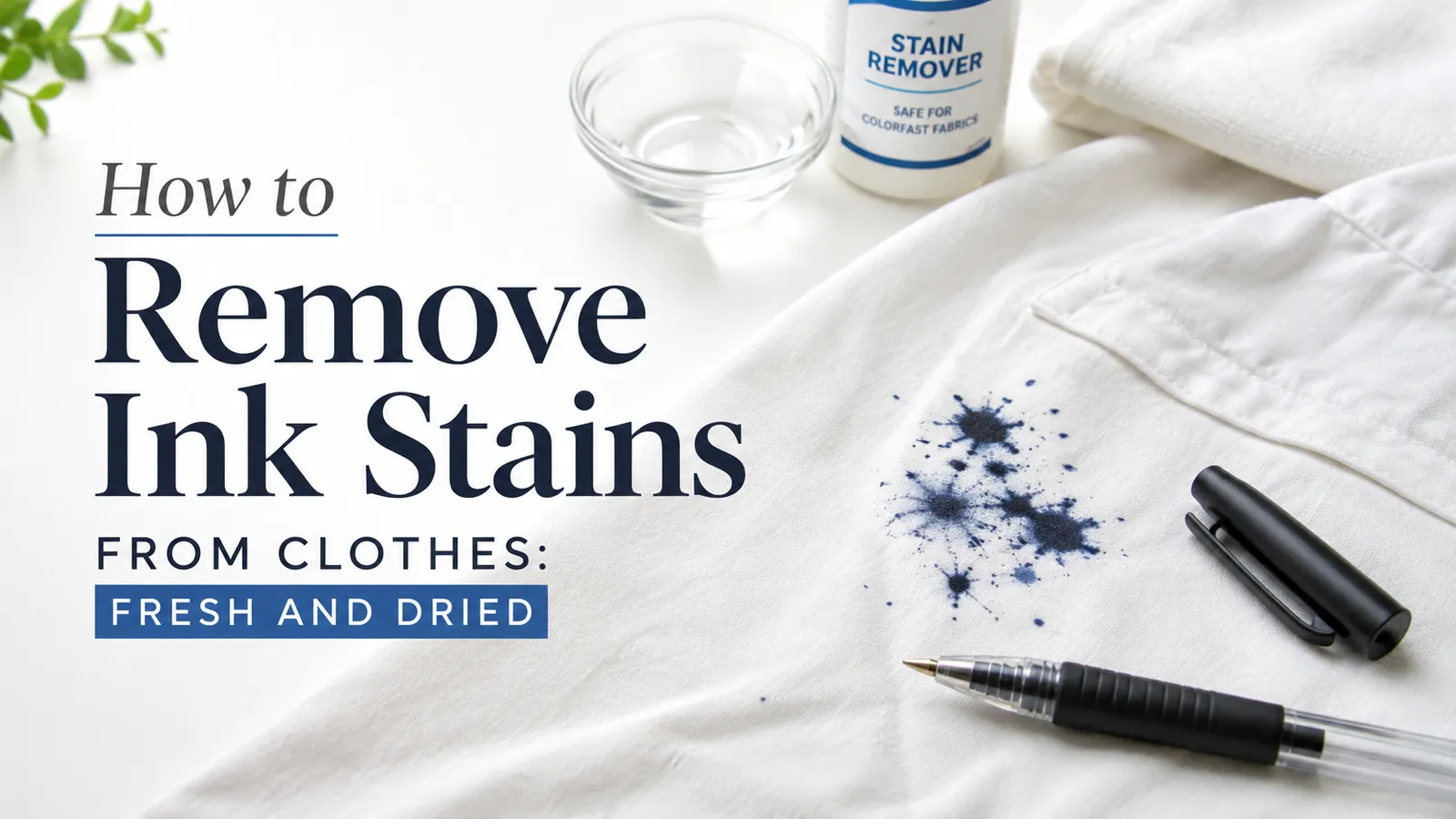
How to Remove Ink Stains From Clothes: Fresh and Dried
Remove fresh and dried ballpoint, washable marker, gel, and permanent ink from clothes using stain identification, blotting, and fabric-safe treatment.
Written by
EverydayFixes Editorial Team
In This Guide
Fast Solution
Quick Answer
Identify the ink before treating it. Place a thick stack of white cloths or paper towels behind the stain and blot without rubbing. Water-based washable ink should normally be rinsed with cool water and pretreated with liquid detergent.
For ballpoint or oil-based ink on compatible washable fabric, patch-test isopropyl rubbing alcohol, apply it from the back with a white cloth or cotton pad, and repeatedly replace the absorbent towel as ink transfers. Rinse thoroughly, pretreat with laundry detergent, wash, and air-dry before inspection.
Rubbing alcohol and ink removers may be flammable and can damage color, acetate, triacetate, modacrylic, delicate finishes, or dry-clean-only garments. Work away from heat and flame, ventilate the area, and patch-test before treating the visible stain.
Time Required
30–90 minutes plus washing and drying
Difficulty
Medium
Best For
Ballpoint pen, washable marker, gel ink, and selected permanent ink stains
Important
Rubbing, dryer heat, untested solvents, and treating every ink the same way
Understand the issue
Why Ink Stains Need Different Treatment Methods
Ink is not one single substance. Washable markers may be mostly water-based, while ballpoint, gel, permanent marker, printer ink, and artist ink may contain different dyes, pigments, resins, oils, and solvents. A treatment that works on one ink can spread or permanently set another.
Successful ink removal depends on controlling transfer. The stain should move from the garment into a clean absorbent pad rather than being rubbed across the fabric. Replacing the towel frequently, rinsing out the treatment, and avoiding dryer heat are as important as choosing the cleaner.
The ink type was not identified
Water-based marker, ballpoint, gel, permanent marker, and printer ink respond differently. Using water on an oil-based ink or solvent on a delicate water-based stain may make the problem worse.
The stain was rubbed
Rubbing spreads dissolved ink outward and pushes pigment into a larger number of fibers.
No absorbent backing was used
Without a clean towel behind the stain, loosened ink can transfer to another layer of the garment or return to the same fibers.
The towel was not replaced
Once the absorbent cloth becomes saturated, continued blotting can redeposit ink onto the garment.
The fabric went through a dryer
Heat can make remaining dye, resin, and binder more difficult to remove and may permanently change delicate fibers.
A cosmetic product was used as a cleaner
Hairspray and hand sanitizer contain varying amounts of alcohol plus fragrance, gels, moisturizers, and other additives that may leave new residue or discoloration.
The solvent was unsafe for the fabric
Alcohol, acetone, and commercial ink removers can affect dye, prints, coatings, acetate, triacetate, modacrylic, and delicate garments.
Prepare first
What You Will Need
Gather these items before starting.
White absorbent cloths or paper towels
Place several layers behind the stain and replace them as soon as ink begins transferring.
Cool water
Useful for washable water-based ink and for thoroughly rinsing treatment from compatible fabric.
Liquid laundry detergent
Use after the ink has been diluted or transferred to remove remaining residue before washing.
70% isopropyl rubbing alcohol
May help with selected ballpoint or oil-based ink on compatible washable fabric after a hidden-area test.
Cotton pads or white cotton swabs
Allow controlled application of alcohol without flooding the surrounding fabric.
Disposable gloves
Useful when working with solvent, printer ink, permanent marker, or a large stain.
Optional commercial ink remover
Use only when the product label lists the fabric and ink type and provides clear rinsing instructions.
Safety and care
Before You Start
Read the garment label and determine the fiber content before using rubbing alcohol or another solvent.
Keep rubbing alcohol, ink remover, and solvent-containing products away from flames, sparks, cigarettes, heaters, and high heat.
Work in a ventilated area and avoid breathing concentrated fumes.
Do not use acetone or nail-polish remover on acetate, triacetate, modacrylic, or an unknown delicate fabric.
Patch-test rubbing alcohol and commercial ink remover on a hidden seam and let the area dry completely.
Do not tumble-dry or iron the garment until the ink is gone.
Dry-clean-only, valuable, lined, coated, embellished, or delicate garments should be taken to a professional cleaner.
Never mix chlorine bleach with alcohol, ammonia, vinegar, acids, peroxide, or another cleaner.
Main method
Step-by-Step Instructions
Follow every step in order for a safer and more reliable result.
Step 1
Identify the ink and fabric
Check whether the stain came from a washable marker, fountain pen, ballpoint pen, gel pen, permanent marker, printer cartridge, stamp pad, or artist ink.
Read the garment label and note whether the fabric is cotton, polyester, denim, acetate, rayon, wool, silk, coated, printed, or dry-clean-only.
Helpful Tip
Keep the pen or marker packaging when possible. Manufacturer information may indicate whether the ink is washable, water-based, or permanent.
Step 2
Protect the clean layers of the garment
Place a thick stack of white towels or paper towels directly behind the stain. Separate the stained layer from the rest of the garment.
Move the absorbent pad as it becomes stained so loosened ink always transfers onto a clean surface.
Step 3
Blot fresh ink without spreading it
Press a clean white cloth against fresh wet ink and lift it straight up. Do not wipe sideways or scrub in circles.
Work from the outer edge toward the center and replace the cloth repeatedly until little additional ink transfers.
Step 4
Treat washable water-based ink
Rinse the stain from the back with cool water. Continue until the water runs clearer and the stain stops releasing easily.
Apply a small amount of liquid laundry detergent, allow the label-approved contact time, then rinse and wash according to the care label.
Step 5
Patch-test alcohol for ballpoint ink
Test 70% isopropyl alcohol on an inside seam. Let the test area dry and check for dye transfer, fading, texture change, or coating damage.
Do not continue if the fabric changes. Use professional care for acetate, triacetate, modacrylic, silk, wool, dry-clean-only clothing, or uncertain finishes.
Step 6
Transfer ballpoint ink into a clean towel
Place the stain face down on a fresh white absorbent pad. Apply a small amount of rubbing alcohol to the back using a cotton pad or swab.
Blot rather than rub. Move the garment and replace the towel each time ink transfers so the dissolved stain is not redeposited.
Step 7
Handle gel or permanent ink cautiously
Gel and permanent inks vary widely. Begin with blotting and a hidden-area test using a product labeled for the ink and fabric.
Permanent pigment may not be fully removable. Stop when additional treatment begins removing garment dye, damaging a print, or roughening the fibers.
Step 8
Rinse out the solvent and pretreat
Rinse the treated area thoroughly according to the care label so alcohol, dissolved ink, and product residue are removed.
Apply a small amount of liquid laundry detergent, allow its approved contact time, and rinse again when required by the product directions.
Step 9
Wash, air-dry, and inspect
Wash the garment separately or with appropriate similar items at the care-label-safe temperature. Use the correct detergent dose.
Air-dry and inspect both sides under good light. Repeat the transfer process if the fabric remains stable and ink is still releasing. Do not use a dryer until treatment is complete.
Choose the right method
Instructions by Material or Surface
Use the instructions that match your item.
White cotton and linen
Best for: Shirts, school uniforms, table linens, and durable white fabric
Rinse water-based ink from the back or use patch-tested alcohol for ballpoint ink. Pretreat with liquid detergent and wash according to the care label.
A compatible oxygen product may help with remaining discoloration after the ink has been transferred and rinsed.
White fabric may still contain colored thread, print, elastic, spandex, or finishing chemicals.
Colored cotton and denim
Best for: Jeans, trousers, shirts, and colorfast everyday clothing
Test rubbing alcohol carefully because garment dye may transfer along with the ink. Use small applications and fresh white towels.
Stop if the treated patch becomes lighter than the surrounding fabric.
Polyester and synthetic blends
Best for: Uniforms, sportswear, and washable synthetic garments
Patch-test alcohol and work gradually because synthetic dyes, prints, coatings, and stretch fibers may react differently.
Avoid high dryer heat and inspect the stain after complete air-drying.
Acetate, triacetate, and modacrylic
Best for: Solvent-sensitive synthetic garments
Do not experiment with acetone or nail-polish remover. Even other solvents should be used only when the garment and product instructions specifically permit them.
Professional cleaning is safer when the fabric content or finish is uncertain.
Some solvents can dissolve, distort, discolor, or weaken these fibers.
Wool, silk, and dry-clean-only garments
Best for: Delicate and valuable clothing
Blot fresh ink without rubbing and take the item to a professional cleaner promptly.
Tell the cleaner what type of ink caused the mark and whether water, alcohol, hairspray, sanitizer, or another product has already been applied.
More options
Alternative Methods
Use these options only when they suit the material.
Commercial ink-stain remover
Best for: A clearly identified ink and compatible washable fabric
Choose a product whose label lists the ink type and fabric. Patch-test, follow its contact time, rinse thoroughly, and keep it away from heat and flame when required.
Do not combine it with alcohol, bleach, or another stain remover.
Water and detergent only
Best for: Washable marker and selected water-based inks
Rinse from the back with cool water, apply liquid laundry detergent, wash, and air-dry.
Starting with solvent may be unnecessary for an ink designed to wash out with water.
Professional cleaning
Best for: Permanent ink, printer ink, dry-clean-only fabric, or failed solvent treatment
A professional can choose a treatment based on the dye, pigment, binder, garment fiber, print, lining, and finish.
Take the item in before repeatedly applying different household products.
Protect your item
Common Mistakes to Avoid
Treating every pen and marker as the same type of ink.
Rubbing fresh ink sideways across the fabric.
Applying treatment without placing an absorbent towel behind the stain.
Continuing to blot onto a towel already saturated with ink.
Using rubbing alcohol without testing garment dye and finish.
Using acetone on acetate, triacetate, modacrylic, or an unknown fabric.
Using hairspray or hand sanitizer without considering fragrance, gel, dye, and moisturizing residue.
Mixing alcohol, bleach, peroxide, vinegar, or another cleaner.
Putting the garment in a dryer while any ink remains.
Optional tools
Helpful Products for This Fix
These product types are optional, not mandatory.
70% isopropyl rubbing alcohol
Best for: Selected ballpoint stains on compatible washable fabrics
Controlled alcohol application may dissolve and transfer some oil-based ballpoint ink into an absorbent pad.
Commercial ink stain remover
Best for: Ink and fabric types listed on the product label
A purpose-made product provides specific directions for application, contact time, rinsing, and safety.
White absorbent cleaning cloths
Best for: Blotting and monitoring ink transfer
A supply of clean white cloths prevents dissolved ink from being repeatedly pressed back into the garment.
Common questions
Frequently Asked Questions
Does rubbing alcohol remove ink from clothes?
It may remove selected ballpoint and oil-based inks from compatible washable fabric. Patch-test first, use it away from heat and flame, blot into clean white towels, rinse thoroughly, and stop if garment dye transfers.
Can hairspray remove ink stains?
Hairspray formulas vary and may contain limited alcohol plus fragrance, oils, polymers, and conditioners that leave another residue. Plain patch-tested rubbing alcohol or a labeled ink remover provides more controlled treatment.
Can hand sanitizer remove pen ink?
Some sanitizer contains alcohol, but gels, fragrance, dye, and moisturizers may leave residue. It is not the preferred treatment when plain isopropyl alcohol or a fabric-labeled ink remover is available.
Can dried ink still be removed from clothes?
Sometimes. Place a clean towel behind the stain, patch-test the appropriate treatment, transfer ink gradually, rinse, pretreat, wash, and air-dry. Permanent or heat-set pigment may not disappear completely.
Can I use nail-polish remover on an ink stain?
Nail-polish remover may contain acetone, dye, fragrance, and oils. Acetone can damage acetate, triacetate, modacrylic, some dyes, prints, and finishes. Use it only when a reliable garment or product instruction specifically permits it.
Why does the ink stain spread when I clean it?
Too much liquid, rubbing, or a saturated backing towel can carry dissolved ink outward. Use small applications, blot instead of rubbing, and replace the absorbent material frequently.
Can permanent marker be completely removed from fabric?
Not always. Results depend on the pigment, binder, fabric, dye, and how long the mark has been present. Stop treatment when garment color or texture begins changing and consider professional cleaning.
Was This Guide Helpful?
Your feedback helps us improve future EverydayFixes guides.
Keep solving
Related Guides
How to Remove Blood Stains From Clothes: Fresh and Dried
Remove fresh, dried, washed, and set-in blood stains from washable clothes using cold water, enzyme detergent, and fabric-safe treatment.
How to Remove Grease Stains From Clothes—even After Drying
Remove fresh, dried, and dryer-set grease stains from clothes using absorbent powder, liquid detergent, careful washing, and repeat treatment.